← Health journal Dermatology

Melagenina Plus for Vitiligo: Evidence, Limits and Questions to Ask

A candid look at the older evidence for Melagenina Plus, how it compares with current vitiligo guidance, and what to ask before considering travel.

Medical disclaimer: This page is for information and international coordination only. It does not diagnose, prescribe, guarantee suitability or replace ongoing dermatological care.
Evidence at a glance

What the current research shows.

The published evidence specifically supporting Melagenina is old and limited, including observational work and laboratory or animal research. Its evidence base is not comparable with treatments addressed in current international vitiligo recommendations, such as established topical therapy, narrow-band UVB or excimer-based phototherapy and selected newer targeted treatments. Suitability and results cannot be promised from a webpage or photographs alone.

The treatment approach

What a Melagenina Plus protocol actually involves.

Melagenina Plus is a topical formulation developed and used in Cuba as part of dermatology practice for vitiligo. It is derived from human placental extract and applied to depigmented skin according to a schedule the treating dermatologist sets for the individual case. In Cuban clinical use, application is commonly paired with controlled, supervised light exposure and followed over an extended course. None of this is self-directed — it sits inside a monitored medical protocol, not a product used independently at home. The sections below break the approach into its individual parts before turning to what a file review requires.

01

Cuban clinical origin

Melagenina Plus was developed in Cuba and has been used there in dermatology practice for vitiligo management for several decades. Its use has been documented mainly within Cuban clinical settings, which is part of why a physician-led review matters before any protocol is considered for a specific case. Reviewing physicians weigh this clinical history alongside the patient's own diagnosis when discussing suitability.

02

Topical application

The formulation is applied directly to depigmented areas of skin, following the concentration and frequency the treating dermatologist sets for the individual case. Application technique and timing are adjusted as the skin responds, rather than following one fixed routine for every patient. Photos taken at intervals help the treating team track how an area is changing.

03

Paired light exposure

Cuban vitiligo protocols involving Melagenina Plus commonly combine topical application with controlled, supervised sunlight or UV exposure. Timing and duration are calculated by clinical staff, since unsupervised sun exposure on depigmented skin carries its own risks. This pairing is part of the protocol design, not an optional step a patient arranges independently.

04

Extended, monitored course

A course typically runs over a period of months rather than weeks, with scheduled check-ins to track how depigmented areas are responding. The length and pace are set individually and can be adjusted as the treating physician reviews progress. Patients are asked to document changes with photos at agreed intervals.

05

Part of a wider protocol

Melagenina Plus is used alongside clinical monitoring, skin assessment and dosage adjustments, rather than as an isolated product used on its own. It functions as one component of a broader vitiligo management plan directed by the treating physician, not a complete treatment by itself. Other measures, including sun protection and routine dermatological care, typically continue alongside it rather than being paused.

06

Physician-directed use

Use is directed by the treating dermatologist at the partner facility for the duration of the course; it is not intended for self-administration without supervision. Any change in the skin, expected or not, is reported back so the plan can be reviewed rather than continued unchanged. This oversight is part of what a physician-led protocol means in practice.

Melagenina Plus for Vitiligo: Evidence, Limits and Questions to Ask
DermatologyMelagenina Plus for Vitiligo: Evidence, Limits and Questions to Ask

A candid look at the older evidence for Melagenina Plus, how it compares with current vitiligo guidance, and what to ask before considering travel.

Before a plan is proposed

What the physician-led file review requires.

Before any protocol is discussed, reviewing physicians need a complete picture of the case. Vitiligo presents differently from one patient to the next, and a thorough file allows for a more informed, individualized opinion rather than a general answer given without documentation. The items below form the core of that file, and missing pieces are usually the reason a response is delayed. None of these items are used to disqualify a patient outright; they are used to give an accurate, individualized answer.

01

Diagnosis confirmation

A confirmed vitiligo diagnosis, ideally from a dermatologist or physician already involved in the patient's care, is the starting point for any review. Where a formal diagnosis has not yet been made, that step should happen locally first. This avoids building a treatment discussion on an assumption rather than a clinical finding.

02

Lesion photographs

Clear photographs showing the location, size and pattern of depigmented areas, taken in consistent, even lighting without filters, help reviewing physicians assess distribution and extent. Photos from more than one angle, and from more than one time point where available, are more useful than a single image submitted alone.

03

Disease history and pattern

How long the condition has been present, whether it appeared suddenly or gradually, and whether it has been stable or actively spreading all shape the discussion. Segmental, non-segmental, localized and generalized patterns are treated differently, so this history is reviewed carefully rather than assumed from photos alone. Recent, fast-moving spread is treated differently in review than a pattern that has been unchanged for years.

04

Previous treatments tried

A record of treatments already attempted, including topical steroids, calcineurin inhibitors, phototherapy or other approaches, along with how the skin responded to each, helps avoid repeating something already tried without effect. Dates and approximate duration of each treatment are useful when available.

05

Skin type and general health

General skin type, along with relevant medical history such as thyroid or autoimmune conditions, current medications and allergies, is reviewed alongside the vitiligo-specific details. Pregnancy status and any known sensitivities are also part of this background, since they can affect both suitability and monitoring.

06

Case-by-case assessment

Reviewing physicians evaluate each file individually; the same protocol is not proposed for every presentation of vitiligo. Some cases may be directed toward a different approach, or toward continued local care, and that determination is made during review rather than promised in advance of seeing the file. This is also why generic online descriptions of the treatment cannot substitute for an individual file review.

Before you begin

Setting realistic expectations for vitiligo repigmentation.

Vitiligo responds differently from one person to another, and from one area of the body to another, even under the same protocol. This section explains, in plain terms, why a specific outcome cannot be promised before a case has been reviewed, and why realistic expectations start with an individual evaluation rather than a general claim. None of the explanations below are meant to discourage inquiry; they are meant to make the inquiry an informed one.

01

Response varies by individual

Repigmentation response varies significantly by individual, by the location of the lesion, and by how long the condition has been present before treatment begins. Facial and neck areas often respond differently than hands or joints, and long-standing, stable patches behave differently than recently spreading ones. No specific outcome, timeline or percentage of repigmentation can be promised in advance.

02

Not every case fits the same protocol

Some patterns of vitiligo, including actively spreading or widespread disease, may be better suited to a different approach, a combination of therapies, or continued local management instead. That determination is made during the physician-led review, based on the documented file, not decided ahead of time. A protocol appropriate for one case is not automatically appropriate for another. Where Melagenina Plus is not judged suitable, physicians may discuss alternative dermatology options instead.

03

Care continues alongside your dermatologist

Coordination through Cuba Health Assist does not replace ongoing care from the patient's treating dermatologist at home; it is designed to work alongside it. Local follow-up remains important during and after any supervised course, particularly for monitoring skin changes between check-ins. Patients are encouraged to keep their home dermatologist informed throughout the process.

Mechanism and use

What Melagenina Plus is and how it is used

Melagenina Plus is a topical product developed in Cuba for vitiligo, containing an extract of human placenta together with calcium chloride. The proposed effect is stimulation of the cells that give skin its colour (melanocytes), encouraging proliferation and melanin production. The approved product information specifies application once daily, at 24-hour intervals, rubbed onto the depigmented areas, and without exposure to an infrared lamp or sunlight.

Setting realistic expectations matters particularly here. Response in vitiligo is measured in months; the face and neck generally respond better, while the backs of hands and feet, the fingertips and the area around the lips repigment far less. Where the disease is active — that is, patches are spreading quickly — the first aim is to halt activity, usually with topical or systemic treatment.

The evidence for Melagenina Plus in international peer-reviewed literature is limited. Most published studies are single-centre, lack a comparison group, or use non-standard outcome measures. Better-defined options exist in vitiligo: topical corticosteroids, calcineurin inhibitors, narrowband UVB phototherapy and, in selected cases, surgical melanocyte transfer. A responsible assessment includes whether those options have been exhausted for this patient.

For this reason a dermatology file should not consist of photographs alone. When the patches began, whether they have spread in the last six months, which treatments were used and for how long, the presence of accompanying autoimmune conditions such as thyroid disease, and current medication all directly affect the suitability decision.

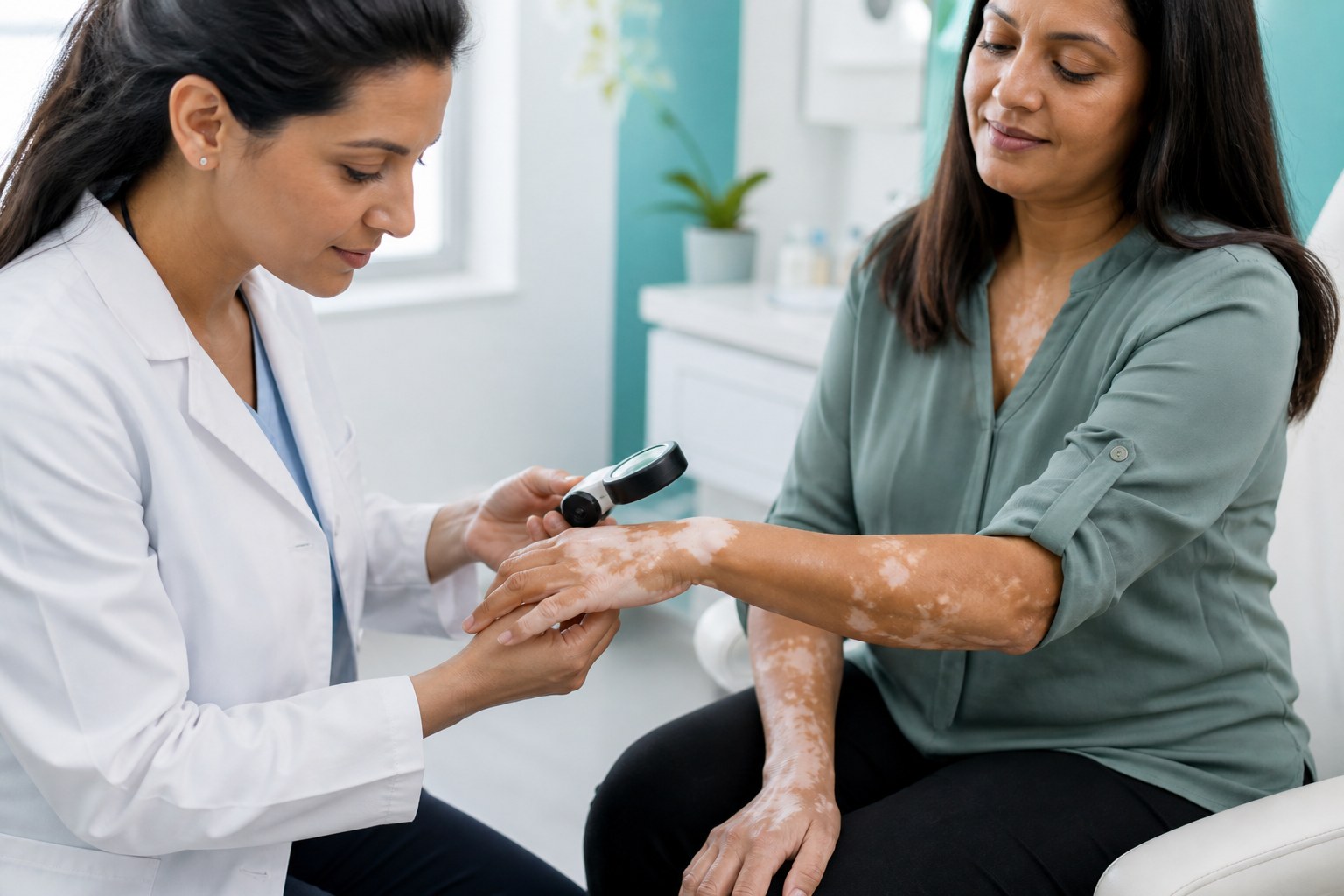
Eligibility and limits

What shapes the assessment in vitiligo

The following directly affect both the treatment decision and the expected response.

01

Active disease

Where patches have spread rapidly in recent months, halting disease activity comes first. Repigmentation attempted during active disease often does not last.

02

Response varies by site

Face and trunk respond relatively better; fingers, backs of hands and feet and the perioral area are the most resistant. Expectations should be discussed site by site.

03

Diagnosis not confirmed

Other conditions causing loss of pigment (pityriasis alba, tinea versicolor, chemical leukoderma) can be mistaken for vitiligo. The dermatological diagnosis must be confirmed before treatment.

04

Accompanying autoimmune disease

Thyroid disease in particular should be investigated and the relevant tests added to the file. This affects both the treatment plan and follow-up.

Frequently asked questions

Common questions about Melagenina Plus

Will Melagenina Plus definitely clear vitiligo?

No, and no such promise can be made. Published data are limited and reported responses vary markedly between patients and between body sites. A realistic goal is acceptable repigmentation and keeping the disease under control.

How long before results appear?

Response in vitiligo is not rapid. Assessment is generally made over months, and the first meaningful change can take several months to appear. Regular use and photographic follow-up are recommended during that period.

Can I obtain and use the product myself?

This is not advised. Confirming the diagnosis, assessing disease activity and reviewing available standard options are medical tasks. In addition, steps such as light exposure after application can cause unwanted skin effects if done incorrectly.

Are there better-evidenced options?

In vitiligo, narrowband UVB phototherapy, topical corticosteroids and calcineurin inhibitors have a better-defined evidence base. In selected stable cases, surgical melanocyte transfer may be considered. A responsible plan covers these options too.

Which documents are needed?

Dermatology consultation note, date of diagnosis, information on spread over the last six months, dated photographs taken at the same angle and lighting, previous treatments and their duration, thyroid function tests and current medication.

Official product information

Melagenina Plus as licensed in Cuba

The data below are taken from the product summary approved by CECMED, the Cuban medicines regulator. They describe the product as licensed in Cuba and are not a treatment recommendation.

Composition
Each 100 mL contains 50% alcoholic extract of human placenta and 100 mg calcium chloride.
Approved indications
Treatment of vitiligo, and depigmentation of the skin caused by burns of any origin.
Route and schedule
Applied by rubbing with the fingers onto the depigmented areas until the patch is covered — once daily, at 24-hour intervals, and without exposure to an infrared lamp or to sunlight.
Contraindications
Corticosteroids and psoralens interfere with the effect of the product. Eruptive skin diseases or other dermatological conditions. Other medicines or treatments indicated for vitiligo.
Interactions
Antagonistic interactions with corticosteroids, psoralens and immunosuppressants.
Reported effects
In some cases skin rash, itching, local irritation, redness and burning at the site of application.

Approval in Cuba does not mean approval in your country, and it does not mean the product is suitable for you. Eligibility is decided by the physician who reviews your complete file.

Start with the file

Start the review with your medical file.

Send your documents through the secure application area. The coordination team will help organize the file and outline next steps.